Tante's sewing machine
The Master Butchers Singing ClubTante’s sewing machine is a black enamel Singer whose promise of useful work changes the course of a difficult negotiation: Tante accepts the prospect of working for Step-and-a-Half, learns to operate the machine, and later buys it instead of acquiring a husband. More than a possession, it becomes the practical center of Tante’s plan to return to Germany and take the boys with her.
A machine that changes the negotiation
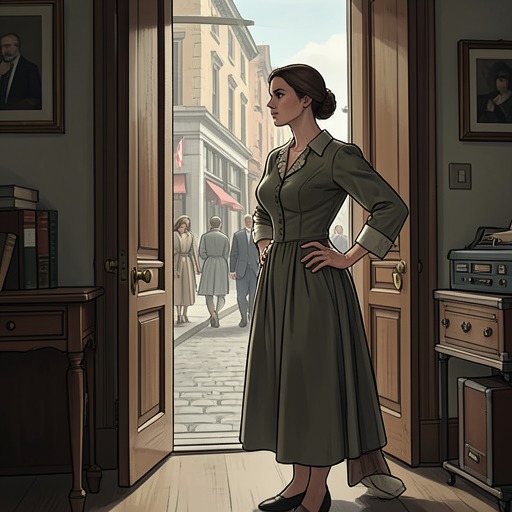
Step-and-a-Half draws attention to the metal-buttoned suit Tante is wearing, and Tante’s response makes clear that the encounter touches a raw point. She insists that the suit is good and costly; it carries her honor and loyalty, so the suggestion that she should wear something else feels like an insult to her clothing. Her need for work collides with her pride at the prospect of working for the woman she once knew as a tattered, flamboyant scrap hauler and now sees as a respectable business owner—and possible employer.
The Singer changes the terms of that confrontation. Step-and-a-Half kicks her foot toward a graceful black electric machine, whose enamel surface is set off by delicate gold flowers and an optional wooden cabinet. Rather than press Tante to change her suit, she offers a way for Tante to work with the garment she already values. The machine thus answers a personal affront with a practical proposition: if Tante can operate it, she can sell it.
Learning to use it
Tante promises to learn. The new model is both streamlined and familiar, and its gleaming needle, chrome flywheel, and polished cabinet absorb her attention. As she touches the cool curve that guides the cloth and runs her hand over the carved oak, the room seems to contract around the Singer; the wider question of working under Step-and-a-Half, and the humiliation that might entail, recedes. The machine does not merely illustrate a solution. Its material presence makes that solution imaginable to Tante before she has resolved her feelings about the employer offering it.
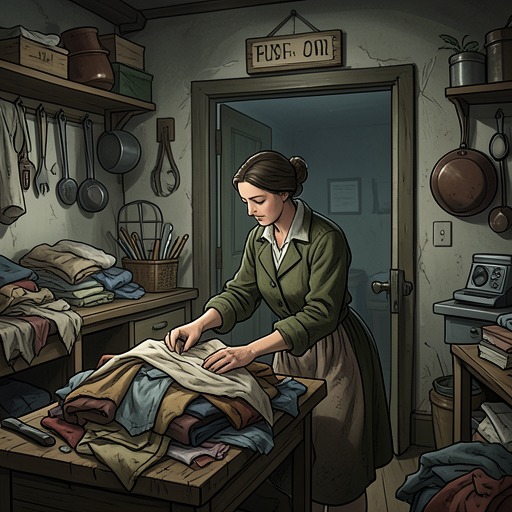
Step-and-a-Half invites Tante to sit down and directs Mrs. Knutson to explain how it works. Tante accepts the instruction and begins learning to thread the needle. Even when Roy Watzka passes carrying purple felt to put in the shop window, she scarcely acknowledges him. Her attention has shifted from the social insult she had been defending against to the concrete task of mastering the Singer.
Purchase and purpose
The machine later becomes Tante’s own. As she prepares to go back to Germany, she has persuaded Fidelis to let her take the boys, except for Franz, who is nearly finished with school. Tante expects to raise them with help from their lonely grandmother. She believes that taking responsibility for the boys will give them a more settled future: they will return to the family’s homeland, grow older, and eventually be old enough to help.
Tante has purchased the Singer rather than acquiring a husband, a choice that makes the machine both an economic asset and a sign of her intended independence. She is confident that she can return with it and establish a useful role for herself. The purchase does not remove the financial pressures around the family’s decision: Fidelis may have been persuaded by bills, by the difficulty of paying Delphine for her work, or by the boys’ needs and accidents. But the machine gives Tante a means of imagining her return as more than dependence on relatives.
A piece of luggage, a plan in motion
On the night the family sets out for Chicago, the machine is secured in the trunk, latched in its traveling case and further crated so it will not be damaged on the voyage. This careful packing places it among the journey’s practical necessities. Tante has also brought a small valise, her large black leather purse, and five boiled eggs; the Singer, however, is the item that connects her proposed future to a specific skill and possible livelihood.
The route has been arranged in stages. The family will drive to Chicago for passport proceedings and consular paperwork; Tante and the boys are then to take a train to New York City and board a ship the following day. Their reserved cabin has a tiny window and an added floor pallet. Against that elaborate movement across roads, railways, and the ocean, the Singer is a compact piece of equipment meant to travel with Tante and make a new household workable. Its journey shows how an object can carry a plan: it begins as Step-and-a-Half’s offer, becomes the focus of Tante’s learning, and ends packed for the return to Germany she expects to make with the boys.